
In this article we are going to explore the the most common forces our joints are exposed to and how they can be catalysts for both acute and chronic injuries. The predominant forces include Compression, Extension, Bending, Torque and Shearing.
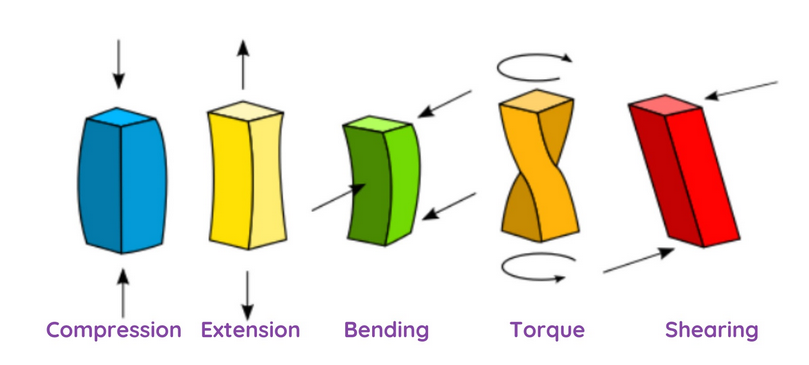
Compression: Involves force being applied to a joint from two opposing directions.
Example: When carrying a heavy weight across your back, the spine has to vertically support that weight. If the joints are stable, the forces are controlled and distributed throughout the body. The problem arises if a joint is unstable or ill-equipped for the situation. The weak link in the chain will leak energy and prove to be a blockage. In the situation of a compromised spinal joint, that vertical energy will compress the vertebra squeezing the disc contained between. If the pressure is great enough or there is existing damage/weakness in the annulus fibers of the disc, it will at best result in a bulging. That compression or loss of space within the joint can pinch nerves as they run through the spine or exit at that joint.
Extension: The opposite of compression, where a joint is being pulled apart.
Example: The shoulder joint is a common site for extension injuries. Catalysts include grabbing an infant or child by the arms and lifting them or swinging them in a circle. While a child's connective tissue is very malleable, you can still do damage. Adult examples include carrying a heavy weight at your side. Without proper shoulder stability there are extreme forces of extension being applied over time. There is also a more acute or sudden application of extension, such as when one tries to do pullups and they can’t or purposely don’t control the lowering phase. It is one thing to lower your weight and hang; it is another to have your weight drop up to 2 feet and have its momentum abruptly stopped.
Fortunately, the shoulder joint has a secret weapon: negative intraarticular pressure. An intact joint capsule has a naturally occurring negative pressure that has been shown to help stabilize the glenohumeral joint in passive and it appears also in dynamic movement. The key is an intact joint capsule. If you have had any surgical procedure which cuts into the capsule, this advantage is lost as the only things holding that joint together are muscle and connective tissue.
Bending: While bending is not a direct concern for the joints, it can be an indirect catalyst.
Example: Bending is more an issue in the long bones of the body such as the femur. An issue may arise if severe bending of the femur is occurring and the body, in a guarding defensive move, purposely allows a joint either above or below to give in an attempt to release energy before bone trauma occurs. In this situation you are likely to see a combination of forces applied at that joint(s).
An adaptive strategy the body has is that bones are living tissue. If you apply stress to them, over time that can increase density overall or in areas where the force is applied. This also assumes the body has the building blocks necessary to make the adaptations.
Torque: Rotational force
Example: Let’s consider the knee. The knee is a hinge. It is designed to flex and extend. As torque is applied, such as when the femur internally rotates, the ligaments, tendons and connective tissue trying to hold the joint in position are stretched. A healthy knee can handle roughly 10 degrees of rotation fairly safely. As you exceed that amount, the risk of tearing or breaking goes up exponentially. If the torque is applied very quickly, less force is required to damage the joint than if it is applied gradually. The key is how quickly the neuro-muscular system can react.
Shearing:
Shearing is where at least one bone of a joint tries to move laterally relative to the other(s); that is, they slide across each other. We can use the knee again as an example. Imagine you are running, and unexpectedly, you step in a muddy depression. Your foot and lower leg catches and momentarily pauses. While the lower leg (tibia and fibula) stops moving, the femur is slow to respond. The momentum of running wants to continue forward, which is exactly what the femur does relative to the lower leg. That motion, even for a split second is enough to place tremendous stress upon the ligaments and tendons designed to brace and stabilize the knee. Connective tissue including ligaments, tendons, cartilage and meniscus can become damaged.
Everyday Examples
While examples of each force are relatively easy to demonstrate, when joint injuries occur, they will likely involve multiple forces applied together. If you recall from the last article, there is an optimal posture or alignment of the joints relative to each other. The design is meant to offer a compromise between optimizing movement potential and maximizing joint stability. It is a fine balance.
Think of the body in a protective or guarding position. What does it look like? If you think of the fetal position, you are correct. While the body is meant to be upright, it is also designed when overwhelmed to collapse in on itself, to form into a ball to brace against itself and to protect the vital tissues and organs within the abdominal cavity and rib cage.
It is this protective mechanism which allows us to understand why and how most injuries tend to occur or may occur in specific situations. When you apply forces to the body beyond its ability to manage, the collapse in on itself helps reduce the forces being applied and dissipates excess energy. I am not sure if this point gets across, but the human body is utterly genius in its design.
Let’s see how this works. I want to use two examples. First is standing under an excessively heavy overwhelming weight. For ease of this lesson, I will focus on what happens from the pelvis downward as this image demonstrates.
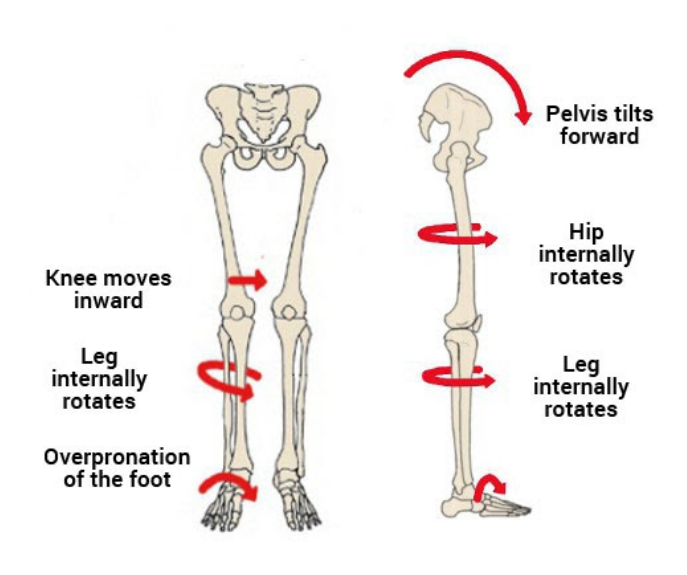
If one is overloaded vertically in a standing position, due to the position of the pelvis, an anterior tilt, the pelvis under load is forced to rotate further forward. As the pelvis rotates forward, it forces the femurs into internal rotation and moves medially allowing an opportunity to brace against each other for added support. The knee joint is exposed to compression, torque and even shearing forces. If needed to protect itself, the body allows the ankles to cave inward (pronate) and the arch to flatten. All these movements can happen in a split second. They are meant to minimize injury, allow for additional support and even offer time to get out of the way of whatever is trying to crush you. Pretty amazing, right!
Let’s now consider a running scenario focusing on the landing phase. In image A, on the left, we have optimal position. The center of the hip is vertically aligned with the center of the knee and ankle. Because of the body’s natural propensity to collapse in upon itself, this body is experiencing forces of compression, shearing and torque at the joints, but the body is able to manage them so the risk of injury is slight.
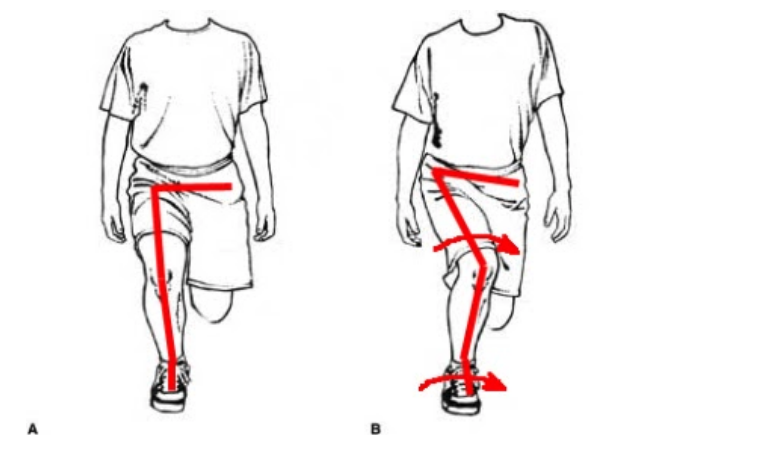
What about image B on the right. This is someone in the same landing phase except they have an unstable pelvis and/or are really tired from excessive repetition or poor recovery over time. Everytime the foot impacts the ground, the energy from their body weight, which can equal 3-7 times your bodyweight, is applied downward. The ability to prevent the collapse inward is compromised. The force of impact drives the femur into internal rotation and every compensation we saw in the standing example is taking place within milliseconds. You don’t have time to think about how to react. This happens each and every step. Is it any wonder we see so many lower body injuries in highly repetitive sport activities?
Is this starting to sink in? Is it beginning to make sense? Maybe the next time you go to the gym you will see things in a different light. All you have to do is look at the people around you the next time you go out shopping. I guarantee you will see poor posture and joint instability in the most basic of movement patterns.
At the end of the day, maybe this info will shed some light on personal injuries or unresolved joint, muscle, and connective tissue challenges. Maybe with better understanding and knowledge of movement, you will be enabled to train smarter and take better ownership of your body. After all, your body/mind is your most valuable asset and it can’t be replaced if abused and broken.
I will offer a hint as to the next topic: Real Strength Comes From Inside! Let me know what you think I am referring to and why...
If you have questions, want to learn more, or are interested in a posture and movement assessment, let me know. I am currently taking on local personal training clients and offering group ELDOA classes.